Private Fund Managers Can Offer Investors an Early Exit
How a fund manager can let investors in a closed-ended private fund sell units early, on a marketplace under its own brand, with the manager approving every transfer.
A fund manager can give investors in a closed-ended private fund a way to sell their units before the fund matures, without losing control of who owns the fund. A secondary marketplace built on Oumla's technology starts from the fund's existing investor register, runs under the manager's own brand, and settles a transfer only after the manager approves it.
A manager runs a seven-year private equity fund that closed three years ago. One investor needs cash and asks to sell. Other eligible investors would buy those units, but the manager has no simple way to bring the two sides together. This use case shows how the platform does it.
The challenge: capital locked until the fund matures
Closed-ended private funds in real estate, private equity and private credit hold investors' capital until maturity. That is often five, seven or ten years away, and plans change in that time. An investor may need cash, see a better opportunity, or simply want out.
When an investor asks to exit early, the process usually runs like this:
- The investor looks for a buyer through personal contacts.
- The two sides agree a price with no market reference.
- The fund manager processes the transfer by hand, through weeks of documents, checks and legal review.
The cost falls on everyone involved:
- Investors have no visible price and no assurance the transfer will complete, so most never try.
- Fund managers carry manual work for every request. Investors who know they cannot get out may think twice before committing to the next fund.
- The ownership record ends up spread across emails and documents, which makes every change hard to trace later.
The solution: Oumla's approach
Oumla's approach rests on four principles:
- Start from what the manager already has. The platform works from the raised fund and its current investor register. Nothing is raised again or restructured.
- Keep the manager in control. Buyers and sellers negotiate, but a trade settles only after the fund manager approves it.
- Build the rules into every trade. Identity checks, the approval step and a log of every action are part of the flow. Each manager sees only its own funds and investors.
- Run it under the manager's brand. A fund manager can run the marketplace under its own name, or one institution can run it for several managers. Managers, investors and the operator each have their own portal.
The platform gives existing fund units a controlled secondary market. It records each investor's units as digital tokens on a permissioned blockchain, a network where only approved participants can take part. Each token represents one unit in the fund's register, and every transfer is recorded.
Each part of the challenge maps to one capability:
| Challenge | How Oumla helps |
|---|---|
| Finding a buyer | Sellers list units on a marketplace open only to investors eligible under the fund's terms |
| Agreeing a price | Listings and bids are visible, and each side can make up to two counter-offers within limits the operator sets |
| Keeping control | Every trade waits for the fund manager's approval before it settles |
| Manual processing | After approval, the platform moves the units, the payment and the fee in one step |
| Tracing changes | Every action is logged with who acted and when |
The fund manager or operator runs the marketplace, and Oumla provides the technology behind it. Every transfer follows the fund's terms and conditions.
How it works: from investor register to settled transfer
The platform starts from what the manager in our example already has: a fund that is raised and an up-to-date investor register. There is no need to raise the fund again or change how it is run.
- Onboard the fund. The manager adds the fund's details, its terms and conditions, and the investor register as a spreadsheet.
- Approve and issue. The operator reviews the fund. Once it is approved, the platform issues each investor's units as tokens to a wallet in their name, matching the register exactly.
- Invite investors. Each investor receives an email invitation, confirms their details and sets up two-step sign-in.
- List and bid. The investor who needs cash lists units with a price and an expiry date. A buyer places a bid, and the buyer's funds are reserved. If the prices don't meet, each side can counter within the operator's limits.
- Manager approves. When buyer and seller agree, the trade waits for the fund manager, who checks that the buyer is eligible to hold the units and approves or rejects it.
- Settle. The units move to the buyer, and the payment, minus a fee shown before confirmation, goes to the seller.
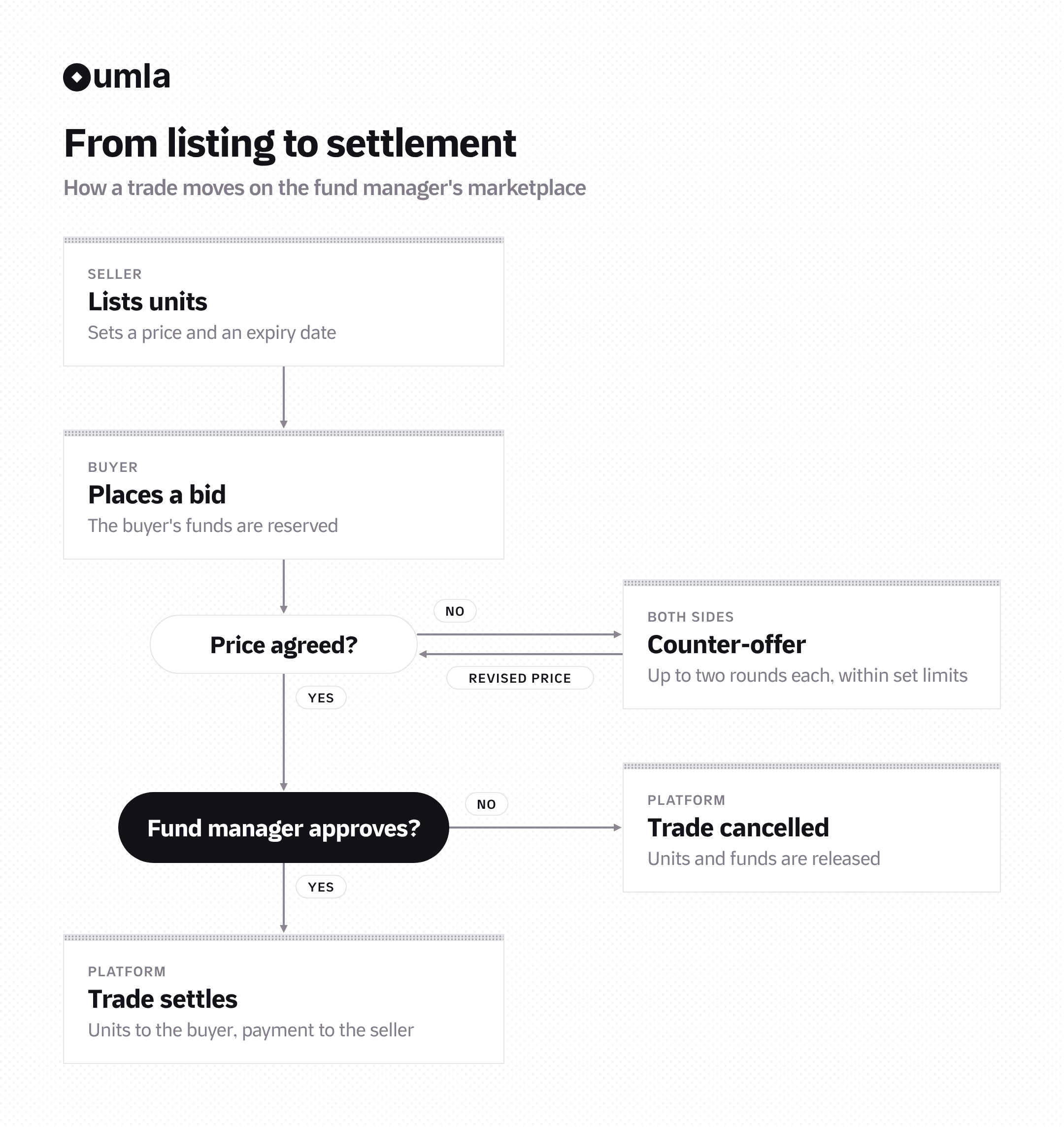
Buyer and seller can negotiate, but only the fund manager's approval lets a trade settle.
The outcome: an early exit becomes a process
An early exit stops being a favor arranged by email and becomes a process, with the fund manager in control at the step that matters.
| Step | Today | With Oumla |
|---|---|---|
| Finding a buyer | Personal contacts | A marketplace of eligible investors |
| Agreeing a price | Private negotiation, no reference | Visible listings and bids, with counter-offers inside set limits |
| Completing the transfer | Weeks of manual paperwork | Settles automatically once the manager approves |
| Manager oversight | Case by case, by email | Every trade approved from one dashboard |
| The record | Spread across emails and documents | One log of every action, who acted and when |
For the investor in our example, leaving the fund early becomes a listing on a screen, not a search for a buyer. For the manager, it becomes one approval instead of weeks of manual work. It also gives the manager a clear answer when investors in the next fund ask how they would get out.
Is this right for you?
This use case fits best if you are:
- A fund manager with closed-ended private funds in real estate, private equity or private credit, and investors who ask about leaving early.
- An institution that wants to run a marketplace for several fund managers, under its own brand.
- Ready to start from your current investor register, without raising the fund again or changing how you run it.
Talk to our team to see the platform and discuss how it would work for your funds.
This article is for information only. It describes an illustrative use case and is not investment advice or an offer of fund units.